
How to Build a Shed: Easy DIY Instructions for Beginners
Ready to build a garden shed that stands up to British weather and adds real value to your home? This beginner shed guide shows you how to build a shed step by step, with simple methods that suit first‑time builders. You will learn safe practice, clear shed construction steps, and UK shed advice drawn from trusted sources such as the Planning Portal, Building Regulations where relevant, and British Standards.
We focus on practical choices for the UK: pressure‑treated timber per BS 8417, roofing guidance aligned with BS 5534, and layouts that cope with rain, frost, and gusty coastal winds. You will see how a solid base, careful framing, and good airflow make a shed last. The DIY shed UK approach here keeps costs sensible while protecting against rot and leaks.
Before you cut a single board, this shed building tutorial explains permissions under permitted development, common height limits, and where setbacks matter. It also introduces materials, tools, and the order of work so you can plan time and budget with confidence. Clear steps help you build a garden shed that is square, dry, and secure.
Inhaltsverzeichnis
Key Takeaways
- Follow a structured shed building tutorial with clear shed construction steps suited to beginners.
- Check the Planning Portal for UK shed advice on permitted development, heights, and placement.
- Use pressure‑treated timber (BS 8417) and roofing to BS 5534 for durability in wet, windy weather.
- Plan a stable base first—concrete slab, paving, or timber bearers—before framing.
- Choose materials and fixings that resist rot and corrosion in UK conditions.
- Sequence work to stay safe, keep timber dry, and maintain a tidy site.
- This beginner shed guide helps you build a garden shed that is compliant, robust, and easy to maintain.
Planning Your Garden Shed Project for UK Conditions
Start with clear shed planning UK goals. Map the plot with a tape measure and a simple site plan. Allow space for door swing, eaves overhang, guttering, and at least 450–600 mm all round for upkeep. Keep the garden shed layout practical and simple so you can build with confidence.
Assessing space, access, and local climate
Check routes from the street to the build area for deliveries and large panels. Good shed access planning means measuring side passages, steps, and tight corners before ordering. Note turning circles for trolleys and space for a skip if needed.
Study the Met Office data for your area. A well-sited UK climate shed faces away from prevailing winds to limit wind‑driven rain. Track the sun path to place doors and windows, reduce glare, and aid passive drying after showers.
Mark the footprint on the lawn with string lines. Confirm square corners and drainage falls. Align paths so barrows and bins can move freely, and leave room to clean gutters and repaint cladding.
Estimating timeframes and complexity for beginners
For first‑timers, a rectangular 2.4 m × 1.8 m build is realistic. Plan two weekends for the structure, plus extra days for base curing, finishes, and snagging. Add float time for rain and frost.
Complexity rises with windows, a pitched roof, electrics, insulation, and lining. Keep the DIY project schedule lean at the start. Expand only when the basics are watertight and square.
Schedule curing: postcrete needs 24–48 hours; a concrete slab needs 5–7 days before loading. Stagger deliveries so timber stays off the ground under tarpaulins.
Creating a realistic project plan and checklist
Sequence tasks from permissions to finishes. Use scaled sketches or a simple planning app to visualise the garden shed layout and cut lists. Note timber lengths to reduce waste and returns.
- Permissions check and boundary review
- Design, material list, and tool hire slots
- Base construction and curing
- Frame, cladding, and roofing
- Doors, windows, and hardware
- Weatherproofing and finishes
Build a beginner shed checklist that tracks lead times, waste management, and storage. Include a wet‑weather plan to protect timber, and ensure shed access planning for concrete, panels, and skip placement.
| Planning Item | Key Actions | Typical Timeframe | Notes for UK Conditions |
|---|---|---|---|
| Site and access | Measure footprint; allow 450–600 mm clearance; verify routes | 0.5–1 day | Account for steps, narrow gates, and neighbour access |
| Climate review | Check Met Office wind, rainfall, frost; set door/window aspect | 1–2 hours | Reduce wind‑driven rain; maximise winter light |
| Base and curing | Lay slab or bearers; protect from rain and frost | 5–7 days (slab set) | Use covers; avoid loading early in cold snaps |
| Structure build | Frame walls/roof; fix square; brace | 2 weekends | Simple rectangular design speeds work |
| Joinery | Fit doors/windows; seals and alignment | 0.5–1 day | Weatherstrips help a UK climate shed |
| Weatherproofing | Felt or shingles; flashings; paint or stain | 1–2 days (dry) | Choose coatings suited to frequent rain |
| Logistics | Tool hire, deliveries, skip permit, storage | Book 3–7 days ahead | Keep materials raised under tarpaulins |
| Checklist and reviews | Update beginner shed checklist; adjust DIY project schedule | Daily 15 minutes | Build in weather delays and snag time |
Understanding UK Regulations, Permissions, and Property Boundaries
Before you mark out the base, check how UK shed regulations apply to your plot. The rules for permitted development outbuildings set the limits for size, height, and placement. Pay close attention to shed height limits UK and the boundary setback rules that protect access and neighbour amenity.
Designated land and listed buildings have tighter controls. In conservation areas, National Parks, Areas of Outstanding Natural Beauty, the Broads, and World Heritage Sites, extra consent may be needed. For Scotland, Wales, and Northern Ireland, review the national guidance as it differs from England.

Permitted development rules and height limits
Most small garden buildings count as permitted development outbuildings when they stay single‑storey and within the height envelope. Typical thresholds include 2.5 m eaves, up to 4 m for a dual‑pitched roof, or 3 m for other roofs. Where a shed sits within 2 m of a boundary, keep the overall height to 2.5 m.
Do not place the structure forward of the home’s principal elevation. Keep site coverage under half the curtilage, excluding the original house. Sticking to these shed height limits UK helps you avoid a planning permission shed application.
Setbacks from boundaries and rights of way
Leave clear space so gutters and eaves do not cross the line. Maintain boundary setback rules that allow you to paint, repair cladding, and install drains without trespass. Keep paths and public rights of way unobstructed to meet access duties.
Allow for fire separation where relevant, especially near fences and other buildings. A modest setback also reduces noise and overshadowing for nearby homes.
When to apply for planning permission or building control
Apply for planning permission shed consent if you exceed height or coverage limits, build on designated land, place the shed in front of the principal elevation, or affect a listed building. Article 4 Directions may also remove normal rights, so verify local status first.
Building Regulations usually do not apply to small detached buildings under 15 m² without sleeping. Between 15–30 m² may be exempt when at least 1 m from boundaries or largely non‑combustible. Any electrical work must meet BS 7671; in England, some domestic work is notifiable under Part P.
Neighbour considerations and party wall issues
Share your layout early to avoid disputes over light, drainage, and access during the build. Agree delivery routes and working hours that minimise disturbance. Clear notes on roof pitch and cladding help set expectations.
The Party Wall etc. Act 1996 rarely applies to free‑standing timber sheds. However, for a party wall shed UK scenario—such as excavations within 3 m of a neighbour’s foundations and deeper than their base—seek advice before digging.
| Topic | Key Thresholds | What to Check | Why It Matters |
|---|---|---|---|
| Permitted development outbuildings | Single‑storey; eaves 2.5 m; 4 m dual‑pitch or 3 m other roofs; not forward of principal elevation | Plot coverage under 50% of curtilage; designated land limits | Staying within UK shed regulations avoids a planning permission shed application |
| Shed height limits UK | Max 2.5 m overall if within 2 m of any boundary | Measure from natural ground level; confirm roof type | Prevents breaches that trigger enforcement or redesign |
| Boundary setback rules | Space for eaves, gutters, and maintenance | Rights of way, covenants, fire separation | Reduces disputes and ensures safe access |
| Building control | Under 15 m² usually exempt; 15–30 m² conditional | Material combustibility; 1 m separation; BS 7671 and Part P | Keeps work lawful and safe, especially with electrics |
| Neighbour and party wall shed UK | Act may engage for near‑boundary excavation | Distance to foundations; depth of dig | Protects structures and maintains good neighbour relations |
Selecting the Best Location for Drainage, Sunlight, and Access
The best place for shed placement is a level or gently sloping patch that sheds water naturally. Prioritise shed location drainage by staying clear of hollows where puddles linger. If the plot sits below a slope, set in land drains or a French drain to avoid damp shed problems and protect the base.
Think about orientation as much as footprint. For sun exposure shed UK guidance, face glazing towards the south or south-east to bring in morning light and to dry cladding faster, which helps limit algae. Turn doors away from prevailing winds so rain does not drive inside during bad weather.
Plan an access route shed users can rely on in every season. Lay firm paths, pavers, or stepping stones wide enough for a wheelbarrow and a lawn mower. Keep the run clear of trip hazards and mud; a compacted sub‑base or resin-bound gravel can work well in small gardens.
Stay clear of large trees. Roots can heave slabs and bearers, while dense canopies drop debris that traps moisture. Maintain a gap from fences to encourage airflow and to keep within height rules when within 2 m of a boundary. This spacing also helps avoid damp shed issues behind the walls.
Consider services early. If you plan a socket or a tap, route external power with armoured cable and consult a qualified electrician, and keep water runs short. Ensure gutters discharge onto permeable ground or into a butt, never across a path or onto a neighbour’s land.

| Site Factor | What to Look For | Why It Matters | Action |
|---|---|---|---|
| Ground Level and Slope | Firm, level or slight fall away from the base | Improves shed location drainage and stability | Grade the area; add compacted Type 1 to the footprint |
| Water Collection | No standing water after heavy rain | Helps avoid damp shed floors and walls | Install French drains; raise the base on bearers if needed |
| Sunlight Orientation | South or south‑east elevation | Optimises sun exposure shed UK and dries cladding | Place windows to the east/south; shade the west in heatwaves |
| Wind and Rain | Doors shielded from prevailing wind | Reduces rain ingress and swelling of timber | Rotate entrance; fit a canopy or drip edge if exposed |
| Access and Movement | Straight, firm access route shed users can navigate | Safe, clean movement of tools and mowers | Lay pavers at least 600 mm wide; ensure flush thresholds |
| Trees and Roots | Outside canopy drip line | Prevents base heave and debris build‑up | Prune overhangs; choose a site clear of large roots |
| Boundaries | Clearance from fences and walls | Improves airflow and compliance near 2 m boundaries | Leave a maintenance gap of 300–600 mm |
| Rainwater Runoff | Permeable ground or water butt | Prevents flooding and neighbour disputes | Fit gutters and downpipes; direct to soakaway or butt |
| Utilities | Proximity to power and water points | Simplifies safe installation and cost control | Use armoured cable outdoors; keep hose runs short |
| Security and Sightlines | Visible from the house, not from the street | Deters theft while keeping a tidy outlook | Angle windows towards the house; use opaque fence panels roadside |
Budgeting for Materials, Tools, and Ongoing Maintenance
A clear DIY shed budget keeps spending on track and helps compare material prices UK before you buy. Factor the full shed cost UK, from the base to finishes, plus future shed maintenance costs and inevitable delivery charges building materials. Prices below reflect small garden sheds and typical merchant rates in Britain.

Cost breakdown: base, structure, roofing, doors and windows
| Element | Typical Options | Indicative Cost (GBP) | Notes |
|---|---|---|---|
| Base | Concrete slab; paving; timber bearers and pads | £150–£400; £120–£300; £80–£200 | Choose for ground type and load; thicker slabs with mesh cost more |
| Structure | Pressure‑treated C24 carcassing; OSB3/ply; fixings | £250–£650 | Check material prices UK; account for nails, screws, ties, and sealants |
| Roofing | Felt; bituminous shingles; EPDM rubber; metal sheets | £60–£120; £120–£250; £200–£450; £250–£500 | Weather exposure and roof pitch guide the choice |
| Doors & Windows | Pre‑hung door set; window units or acrylic | £120–£300; £40–£150 | Include hinges, hasps, locks, and draught seals |
| Membranes & Insulation | Breather membrane; DPM; PIR or mineral wool | £70–£350 | Improves lifespan and comfort; reduces future shed maintenance costs |
| Finishes & Hardware | Exterior paint/preservative; stainless/galvanised fixings | £50–£150; £60–£180 | Better coatings and fixings protect your investment |
| Tool Hire (per day) | Mitre saw; SDS drill; plate compactor | £25–£40; £20–£35; £35–£50 | Hire only for build days to control the DIY shed budget |
Buying new vs. reclaimed materials
A reclaimed timber shed can trim the overall shed cost UK and cut waste. Pallets, scaffold boards, or reclaimed slate from local yards can work well.
Sort and de‑nail stock, check for rot or twist, and confirm structural pieces are straight. Watch for hidden metal when cutting, and use new fixings with reclaimed boards for safety.
Where to save and where to invest for durability
Spend on pressure‑treated timber to BS 8417 (UC3b/UC4), a robust base, quality roofing, and stainless or galvanised fixings (A2/A4 where exposed). These choices lower long‑term shed maintenance costs.
Save on decorative trims and internal shelves you can add later. Shop around on material prices UK at Wickes, Jewson, and Travis Perkins to sharpen your DIY shed budget.
Allowing contingency and delivery charges
Add a 10–15% contingency for waste, breakages, and tweaks. Budget for delivery charges building materials from merchants and tool hire firms, plus mileage surcharges in rural areas.
Include skip hire at £150–£300 and, if it sits on the road, a council permit. These extras can sway the real shed cost UK, even with a careful DIY shed budget.
Essential Tools and Safety Equipment for Shed Building
Set up your kit before the first cut. A clear shed tools list helps you work faster and safer, especially if you’re choosing beginner carpentry tools for a first build. Keep PPE for DIY close at hand and follow site safety UK guidance from the outset.
Measure twice, cut once applies to services as well as timber. Before groundworks, plan an underground cable check and consider CAT scanner hire to verify routes. Good prep prevents delays and costly errors.

Hand tools and power tools for beginners
- Core hand tools: tape measure, combination square, speed square, chalk line, spirit level, hammer, nail punch, utility knife, hand saw, a set of chisels, clamps, and a caulking gun to seal gaps.
- Power tools: a cordless drill/driver with a wood bit set, impact driver, circular saw or mitre saw for straight, accurate cuts, a jigsaw for curves and notches, an SDS drill for anchor fixings, a multi‑tool for trimming, and an orbital sander for smooth finishes.
- Optional upgrades: a nail gun for rapid fixing, a planer for edges, and a router for neat door rebates.
Choose reputable brands such as DeWalt, Makita, Bosch Professional, or Metabo for reliability. Arrange the shed tools list by task so you can stage the build and avoid clutter.
Personal protective equipment and site safety
- PPE for DIY: safety glasses to EN166, SNR‑rated ear defenders, cut‑resistant or general‑purpose gloves, and an FFP2 or FFP3 respirator when cutting treated wood or insulation.
- Footwear and clothing: steel‑toe boots with good grip and weather‑appropriate layers to stay dry and visible.
- site safety UK basics: keep the site tidy, store fuel and adhesives away from flames, use RCD protection on corded tools, and ensure blades are sharp with guards in place.
- Access control: mark exclusion zones for children and pets, secure ladders to BS EN 131 standards, and avoid roof work in high winds or rain.
Good habits reduce risk and raise build quality. A short pause to kit up is quicker than a trip to A&E.
Cable, pipe, and underground service checks
- Start with an underground cable check: review utility plans if available and look for service entry points such as meter boxes and inspection covers.
- Use a cable avoidance tool with a signal generator where possible; CAT scanner hire is widely available from UK hire shops including HSS Hire, Speedy, and Brandon Hire Station.
- Mark detected routes with chalk or spray, set safe offsets for posts and slabs, and use hand digging near indicated lines. Regional “dial before you dig” services can provide extra guidance.
Document your findings on the project drawing. This simple step protects your schedule, budget, and everyone on site.
Choosing Materials: Timber, Cladding, Roofing, and Fixings
Start with strong framing. Use C16 or C24 timber; the latter is straighter and carries heavier loads, ideal for joists and rafters. Opt for pressure-treated timber UK to BS 8417. Choose UC3b for studs and battens and UC4 for posts and bearers to resist decay in damp soil.
Sheathing adds stiffness. Compare OSB3 vs plywood at 11–18 mm for racking strength. Seal cut edges with exterior-grade sealer to keep out moisture. A breathable membrane behind the skin reduces interstitial condensation, and leave vent gaps at the eaves and base.
Pick from practical shed cladding options. Tongue-and-groove shiplap looks smart and sheds water well. Featheredge boards give a traditional style and need correct overlap on counter-battens. Composite cladding cuts upkeep and keeps colour for longer in harsh weather.
Roofing should suit budget and lifespan. Weigh EPDM vs felt roof for ease and years of service. Mineral felt is affordable for a starter build, while EPDM rubber has long life and few seams. Bitumen shingles add texture, torch-on felt lasts longer with pro fitting, and corrugated metal is light—use anti-condensation backing to curb drips.
Choose durable fixings throughout. Select galvanised fixings or stainless steel for exterior use. Annular ring-shank nails grip cladding. Structural screws from brands like Spax or TIMco pull frames tight, and coach screws or through-bolts secure ledgers and bearers. Fit corrosion-resistant hinges and add silicone or EPDM seals at vulnerable joints.
Protect from ground moisture with a 1200-gauge polythene DPM under slabs and DPC strips beneath sole plates. Add guttering to manage run-off; uPVC systems from FloPlast or Marley keep water away from the base and help prevent splash-back on walls.

| Material Choice | Best Use | Key Benefit | Notes |
|---|---|---|---|
| C24 timber | Floor joists, rafters | Higher strength and straighter lengths | Specify kiln-dried, minimise twist during install |
| Pressure-treated timber UK (UC3b/UC4) | Studs, battens, bearers, posts | Resists rot and insect attack | UC4 for ground contact; confirm BS 8417 treatment class |
| OSB3 vs plywood (exterior/WBP) | Wall and roof sheathing | Racking strength for square, rigid frames | 11–18 mm; seal edges to block moisture ingress |
| Shed cladding options | External walls | Balances appearance, cost, and upkeep | Shiplap for weathering, featheredge for heritage, composite for low maintenance |
| EPDM vs felt roof | Weatherproof covering | Service life vs upfront cost | EPDM 20+ years, mineral felt budget-friendly, torch-on felt needs pro installation |
| Galvanised fixings and stainless steel | Framing, cladding, hardware | Corrosion resistance outdoors | Use ring-shank nails for cladding; structural screws (Spax, TIMco) for frames |
| DPM/DPC and guttering | Moisture control and drainage | Prevents damp rise and splash-back | 1200-gauge DPM, DPC under sole plates, uPVC gutters by FloPlast or Marley |
Site Preparation and Marking Out the Footprint
Good groundwork sets the tone for the entire build. This site prep shed stage focuses on clean lines, firm support, and reliable water control so your structure stays true and dry year after year.

Clearing vegetation and levelling ground
Strip turf and organic topsoil with a spade or turf cutter until you reach firm subsoil. Compost green waste or take it to a licensed tip. Aim for a level ground shed platform that is stable and free of roots and soft patches.
For paving or slabs, lay 75–100 mm of MOT Type 1 in well-compacted layers using a plate compactor. Check levels across several points with a laser or a long spirit level to avoid dips that invite water and undermine shed drainage.
Setting string lines, pegs, and square corners
Drive timber pegs at the corners, then run taut lines to mark out footprint edges. Confirm squareness by matching diagonal measurements or use the 3‑4‑5 method for quick accuracy. Re-check line heights against a baseline to keep the whole layout true.
Mark door swings and access routes now so you can position paths and gutters later. Small adjustments at this stage save time when fixings and cladding go on.
Planning for drainage and damp-proofing
If the plot is damp or clay-heavy, install a French drain garden around the perimeter: a trench with a perforated pipe wrapped in geotextile and backfilled with clean gravel, sloped to a soakaway where allowed. Tie in gutter falls at 1:600–1:350 and plan downpipes to discharge to permeable ground or a water butt.
For concrete slabs, include a 1200‑gauge DPM for shed beneath the pour and a DPC under wall plates. For timber bearers, use UC4 treated sleepers or posts on concrete pads with DPC packers or plastic pedestals to maintain airflow. These details strengthen shed drainage performance and protect the base for the long term.
Foundations and Bases: Concrete Slab, Paving, or Timber Bearers
Choosing among the main shed base types shapes how sturdy, dry, and long‑lasting your build will be in a shed foundation UK context. Match the base to soil, slope, and shed size to keep floors level and doors true through the seasons.
A concrete slab shed offers a tough, permanent platform. Pour 100 mm of concrete with A142 steel mesh over a compacted sub‑base and sand blinding. Use formwork, lay a DPM, and trowel the surface slightly proud to shed water. On larger pads, include an expansion joint, keep the slab damp for 3–5 days, and avoid heavy loads for about a week.
For smaller footprints, a paving slab base is cost‑effective and quick. Set 450×450 or 600×600 slabs on a 30–50 mm mortar bed above a compacted sub‑base. Check level across the whole footprint and fill joints with mortar or kiln‑dried sand to lock the surface.
A timber bearer base lifts the floor clear of splashback and speeds the job. Place UC4 treated bearers on level concrete pads or adjustable pedestals at 600–800 mm centres. Add cross‑bracing to stop racking and use joist hangers where spans demand. Always isolate timber with DPC strips and maintain ventilation gaps to reduce rot.
On sloping or wet plots, ground screws or helical piles minimise excavation. Install with a torque driver and fix a treated timber frame to the heads using galvanised brackets. In exposed locations, anchor the shed to the base with concrete anchor bolts, frame fixings, or hurricane ties to resist uplift.

| Base Type | Best For | Build Details | Pros | Considerations |
|---|---|---|---|---|
| Concrete slab shed | Large sheds, heavy loads, long service life | 100 mm slab, A142 mesh, compacted sub‑base, sand blinding, DPM, trowelled finish, cure 3–5 days | Very durable, level, low maintenance | Higher cost, more labour, permanent once poured |
| Paving slab base | Small to mid‑size sheds and tight budgets | 450×450 or 600×600 slabs on 30–50 mm mortar over compacted sub‑base; joints filled | Cost‑effective, modular, easy to repair | Needs precise levelling; movement on poor sub‑soil |
| Timber bearer base | Speedy builds, uneven ground, airflow under floors | UC4 bearers on pads/pedestals at 600–800 mm centres, cross‑bracing, joist hangers, DPC isolation | Fast to install, elevated and well‑ventilated | Ongoing checks for fixings and treatment; requires accurate bracing |
| Ground screws | Sloping sites, minimal digging, sensitive gardens | Helical screws installed by torque driver; timber frame fixed with galvanised brackets | Clean install, reusable, immediate loading | Special tools; verify capacity for soil type |
Whichever option you choose from these shed base types, keep drainage in mind and align methods with standard practice in the shed foundation UK. Good detailing at the base prevents damp, keeps floors straight, and protects your investment for years.
how to build a shed
Follow clear shed assembly steps that suit UK weather and timber sizes. This approach suits beginner carpentry UK while still meeting structural needs. Keep checking line, level, and square so parts fit first time.
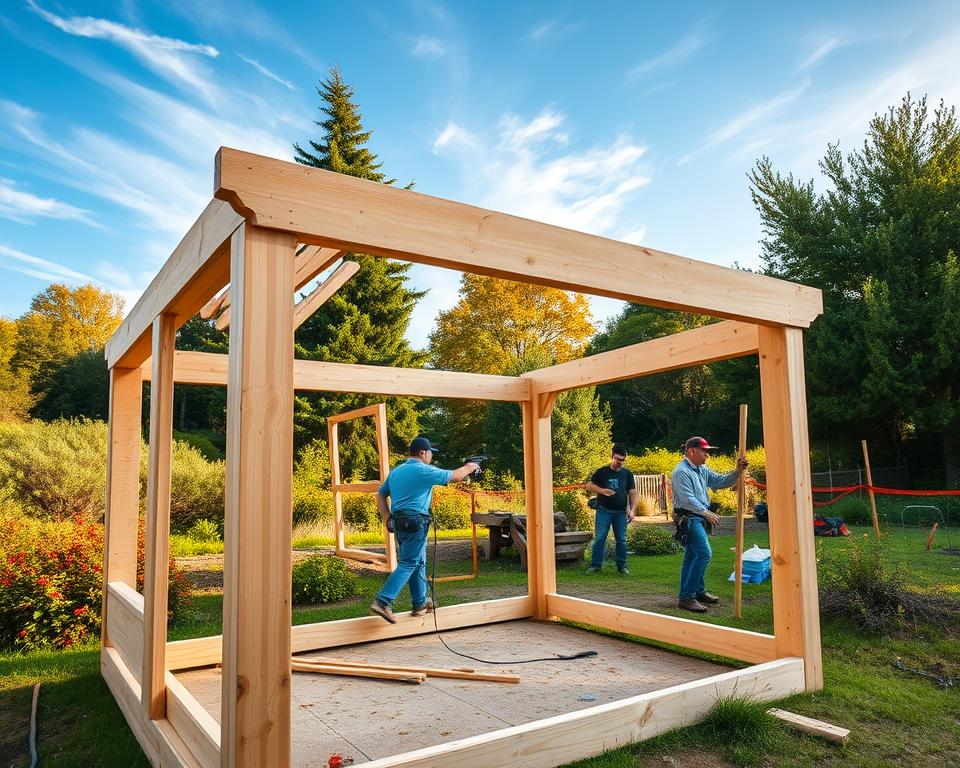
Framing the floor, walls, and roof in sequence
Start shed framing with a rectangular base of treated joists, such as 47×100 or 47×125 mm, set at 400–600 mm centres. Check level and square, then anchor to bearers or a solid base with frame anchors. Lay 18 mm exterior plywood or OSB3, stagger the sheets, leave 3–5 mm gaps, and seal the edges.
Next, build shed walls flat on the deck using 47×75 or 47×100 mm studs at 400 or 600 mm centres. Add double top plates and headers over door and window openings. Sheath panels with 9–11 mm OSB3 for racking strength before lifting.
Stand panels, fix to the floor with structural screws, and brace plumb. Fit a breather membrane, then add vertical battens to form a ventilation cavity ready for cladding.
Set the roof to suit the design. For a pent, cut a fall of at least 1:40 for EPDM and fix with birdsmouths or hangers. For a gable, use a ridge board with pairs of rafters, plus collars or ceiling ties. Sheath with OSB3, lay a BS 5534-compliant underlay, then your chosen finish.
Fixing methods for strong, square joints
Build strength with corner brackets, nail plates, and structural screws. Aim for true square joints by checking diagonals match. Pre-drill near board edges to prevent splitting, and use construction adhesive where it adds stiffness.
Choose fixings with the right length and spacing for each layer. This matters at plate joins, sheathing edges, and when setting roof rafters UK to the wall plates.
Weatherproofing as you go to protect timber
Lay DPC under sole plates before you fix walls to the deck. Tape membrane overlaps and seal cuts to stop wind-driven rain. If showers threaten, cover exposed roofs with a taut tarpaulin until finishes go on.
Keep ventilation pathways open at eaves and the ridge or the high point of a pent roof. Use soffit vents or mesh to block pests while allowing airflow.
Quality checks at each stage
Confirm equal diagonals on the floor and walls to prove square. Check studs at consistent centres, walls plumb, and correct overhangs for eaves and gutters. Verify that roof rafters UK align and seat fully along the plates.
Review every fixing run against the manufacturer’s guidance. These shed assembly steps help beginner carpentry UK projects stay straight, with secure square joints that last.
Installing Doors, Windows, and Secure Hardware
A solid entrance and bright glazing make a shed useful in all seasons. Choose parts that suit UK weather, then fit them with care so they last. Balance ease of use with shed locks security and anti-theft hardware from the start.

Hinge choice, alignment, and weather seals
To fit shed door properly, select corrosion‑resistant T‑hinges or cranked strap hinges sized at least one‑third of the door height. For heavy doors, rising butt or adjustable options keep the leaf true. Many shed hinges UK ranges include galvanised and stainless steel; match them to coastal or exposed sites.
Hang the door to a plumb frame with 2–3 mm clearance on the sides and head. Use three hinges on taller leaves and through‑bolt with coach bolts to resist prying. Add a threshold or drip bar, compressible weather seals door around the frame, and a rain guard over the head to stop wind‑driven rain.
Fitting glazing safely and securely
Choose glazing acrylic for impact resistance and light weight, or toughened safety glass to BS EN 12150 for a crisp view. Bed the pane on butyl or EPDM tape, then secure with timber beading and stainless pins to avoid rust marks. If using plastic sheets, apply non‑acetoxy silicone compatible with acrylic to seal edges.
Keep sightlines neat and avoid over‑tightening fixings, which can stress panes. Where security matters, pair clear glazing with an internal grille or polycarbonate liner to deter attack while keeping daylight high.
Locks, hasps, and security considerations
Combine a concealed‑fix hasp and staple with a closed‑shackle padlock carrying a recognised CEN rating. Add hinge bolts, security screws, and anti-theft hardware so fasteners cannot be removed from outside. For framed doors, a keyed mortice or sash lock improves shed locks security without spoiling the look.
Reinforce windows with beading fixed from the inside and consider motion‑activated lighting. Install anchor points for bikes and tools, and a ground anchor tested by Sold Secure for high‑value kit. These measures work with shed hinges UK standards to create a balanced barrier that still feels easy to use.
| Component | Recommended Option | Why It Matters | Security Tip |
|---|---|---|---|
| Hinges | Galvanised T‑hinges or cranked straps (min. 1/3 door height) | Spreads load and resists sagging in UK weather | Through‑bolt with coach bolts; add hinge bolts |
| Door Alignment | Plumb frame with 2–3 mm clearances | Prevents binding and premature wear | Use three hinges on tall or heavy doors |
| Weatherproofing | Threshold/drip bar, compressible weather seals door, rain guard | Keeps out wind‑driven rain and draughts | Seal cut ends to stop moisture ingress |
| Glazing | Glazing acrylic or toughened glass (BS EN 12150) | Acrylic is impact‑resistant; glass offers clarity and safety | Bead from inside; use stainless pins |
| Sealants/Tapes | Butyl or EPDM tape; non‑acetoxy silicone for plastics | Long‑lasting seal without attacking acrylic | Avoid over‑compression to prevent cracks |
| Locks | Closed‑shackle CEN‑rated padlock; keyed mortice/sash lock | Deters bolt‑cutters and prying | Concealed‑fix hasp and staple; security screws |
| Additional Measures | Motion lighting; internal anchor points | Improves deterrence and kit protection | Pair with anti-theft hardware and property marking |
Key takeaway: specify parts once, install once, and enjoy a door and window set‑up that looks smart, keeps weather out, and stands up to tampering.
Weatherproofing, Insulation, and Ventilation
A dry shed starts at the base. Lay a DPC beneath sole plates for robust shed damp proofing, then detail flashings and drip edges so rain sheds cleanly. Behind cladding, fit a taped breathable membrane and keep a 20–25 mm ventilated cavity to move moisture away from timber. Roof coverings benefit from an underlay, neat bargeboards, and fascias with a decent overhang.
For year‑round comfort, choose materials that suit shed insulation UK norms. PIR boards such as Celotex or Kingspan sit snug between studs and rafters; seal joins with foil tape to limit air leaks. Mineral wool also performs well when paired with a continuous vapour control layer on the warm side, following BS 5250 guidance for moisture risk.
Good airflow protects structure and tools. Fit a 10 mm eaves gap on cold roofs and add high‑level outlets for balanced intake and exhaust. Use trickle vents in windows and louvred ventilation grilles at opposing walls to aid condensation control without draughts. Seal service penetrations, but avoid creating a sealed box.
Finish the envelope with care. Treat all cut timber ends, fit gutters, and keep them clear. Send downpipes to a soakaway or water butt to reduce splashback at the base. These simple steps extend coating life and keep the interior stable.

| Layer/Feature | Purpose | Recommended Practice (UK) | Helps With |
|---|---|---|---|
| DPC under sole plates | Stops ground moisture wicking into timber | Continuous strip beneath all load lines | Shed damp proofing |
| Breathable membrane | Blocks rain ingress while allowing vapour to escape | Taped seams behind cladding with 20–25 mm cavity | Condensation control |
| Roof underlay and overhangs | Secondary weather barrier and drip protection | Include bargeboards and fascias for clean run‑off | Weatherproofing longevity |
| PIR or mineral wool | Thermal resistance for comfort | PIR (Celotex, Kingspan) taped; or mineral wool with VCL | Shed insulation UK |
| Vapour control layer | Limits moisture entering the fabric from inside | Continuous, sealed at joints and edges to BS 5250 intent | Condensation control |
| Eaves and high‑level vents | Encourages cross‑flow ventilation | 10 mm eaves strip plus ridge or gable outlets | Ventilation grilles and airflow balance |
| Trickle and louvred vents | Background air change without draughts | Windows with trickle slots; louvres on opposite walls | Condensation control |
| Gutters and downpipes | Manages rainwater away from base | Direct to soakaway or water butt; keep clear of debris | Shed damp proofing |
Balance layers that shed water with systems that let the structure breathe, and the shed will stay sound through British weather.
Exterior Finishes, Paint, and Preservation Treatments
Good exterior finishes protect the structure, sharpen the look, and cut future costs. In the United Kingdom, a smart choice of exterior wood paint UK or shed stain works best when paired with a robust preservative. Start with sound timber care, then match the finish to the style and use of the shed.
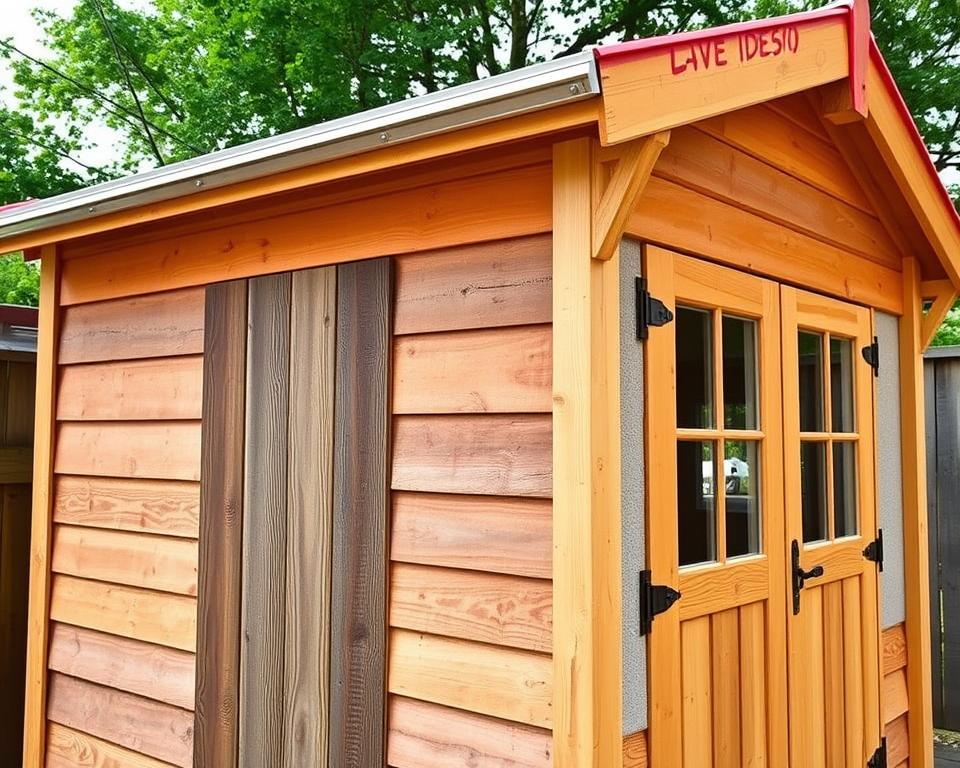
Primers, stain, paint, and preservative choices
Apply a fungicidal and insecticidal treatment to suit timber preservative BS 8417 guidance, including end-grain on cuts and notches. Pressure-treated boards still benefit from extra attention at exposed edges. For colour and film build, choose a translucent shed stain from brands like Sadolin or Sikkens, or an opaque, microporous system such as Dulux Weathershield or Bedec Barn Paint.
If you prefer a natural look, oils such as Osmo UV-Protection Oil enrich grain and are easy to refresh. Decide early on oil vs acrylic paint: oils offer rich depth and simpler patch repair; water-borne acrylics dry fast and hold colour well. For steel fixings and hinges, use compatible metal primers to resist corrosion before topcoating.
Preparing surfaces for a long‑lasting finish
Thorough surface prep timber sets the finish up for success. Check the moisture content meets product guidance, ease sharp edges, and remove dust. If using light colours, spot-prime knots with a shellac-based primer to lock in resin and prevent blemishes.
Work in fair weather, ideally 10–25°C with dry air and low wind. Follow manufacturer coverage rates and coat all faces where you can, paying extra attention to end grain and exposed edges. This careful approach helps any exterior wood paint UK or oil system perform to its stated life.
Maintaining finishes through the seasons
Plan a simple shed maintenance schedule. Inspect in spring and autumn, wash down with a soft brush, and clear gutters to keep water off cladding. Trim nearby plants to improve airflow and reduce damp that can shorten the life of a shed stain or paint film.
Touch up damage as soon as it appears. Expect to recoat stains and paints on a 3–7 year cycle, and oils every 1–3 years, depending on exposure and shade. Small, regular tasks keep coatings sound and the timber beneath protected under timber preservative BS 8417 principles.
| Finish Type | Best For | Key Brands (UK) | Pros | Considerations | Typical Recoat |
|---|---|---|---|---|---|
| Translucent Shed Stain | Visible grain, colour tone | Sadolin, Sikkens | Enhances timber character; good UV resistance | Shows substrate marks; needs solid surface prep timber | 3–5 years |
| Opaque Microporous Paint | Uniform colour, higher coverage | Dulux Weathershield, Bedec Barn Paint | Hides defects; strong weathering; wide colour range | Film failures if end grain unsealed; prep is critical | 5–7 years |
| Exterior Oil | Natural look, easy refresh | Osmo UV-Protection Oil | Simple spot repairs; nourishes timber | More frequent recoats; limited colour shift | 1–3 years |
| Preservative (BS 8417 aligned) | Biological protection, end-grain defence | BS 8417 compliant ranges | Guards against rot and insects; supports finish longevity | Not a decorative topcoat; must be overcoated when exposed | Per product guidance |
| Oil vs Acrylic Paint | Choosing drying time, repair method | Multiple UK ranges | Oil: rich flow, forgiving repairs; Acrylic: fast dry, colour hold | Oil: slower dry; Acrylic: needs careful prep for adhesion | Align with shed maintenance schedule |
Conclusion
This DIY shed UK conclusion brings the project full circle. With clear planning, the right tools, and respect for UK rules, a first build is well within reach. Start with a firm, well-drained base and pressure-treated timber. Add a breathable membrane and a durable roof to stand up to rain, frost, and wind.
Keep to permitted development limits, honour boundary set-backs, and plan access and drainage from day one. Work in order: prepare the site, lay the base, frame floor and walls square and plumb, set the roof with the correct fall, then fit doors and windows. Seal joints, prime exposed cuts, and ventilate to avoid damp and condensation. If you add electrics, hire a qualified electrician to BS 7671.
This shed building summary shows that careful steps lead to a robust, tidy result. Use stainless or galvanised fixings, reliable membranes, and quality coatings suited to the UK climate. Check alignment at each stage so the structure stays true and secure.
Your next steps shed plan is simple: schedule seasonal checks, wash down and refresh paint or stain, and clear gutters to maintain a shed UK standard of care. With routine upkeep, you will protect the timber, keep the interior dry, and enjoy long service life from a shed that adds value and useful space to your garden.
FAQ
Do I need planning permission to build a shed in the UK?
Most garden sheds fall under permitted development if they meet Planning Portal criteria. Keep eaves at or below 2.5 m, overall height at 4 m for a dual‑pitched roof or 3 m for other roofs, and avoid placing the shed forward of the principal elevation. If the shed is within 2 m of a boundary, the whole building must not exceed 2.5 m in height. Different rules may apply in conservation areas, National Parks, AONBs, and for listed buildings—check with your Local Planning Authority.
How close can my shed be to the boundary or a neighbour’s fence?
Allow at least 450–600 mm around the shed for maintenance and to prevent moisture traps. If you build within 2 m of a boundary, keep the overall height to 2.5 m. Ensure eaves and gutters do not overhang the boundary and avoid obstructing rights of way or breaching covenants. Engage neighbours early to discuss access and overshadowing.
What is the best base: concrete slab, paving slabs, or timber bearers?
A concrete slab offers the most robust, level base and suits heavy loads. Paving slabs are cost‑effective for smaller sheds and easier to install. Timber bearers or ground screws provide a quick, elevated solution with good ventilation, ideal for sloping sites. Always use a 1200‑gauge DPM under slabs and DPC strips under sole plates to control damp.
Which timber should I use for a durable shed frame?
Choose structural C16 or C24 timber; C24 is straighter and stronger for joists and rafters. Use pressure‑treated timber to BS 8417: UC3b for above‑ground elements such as studs and battens, and UC4 for ground contact like bearers and posts. Treat cut ends and notches with end‑grain preservative.
What cladding and roofing options work best for UK weather?
For cladding, tongue‑and‑groove shiplap offers good weathering, while featheredge provides a traditional look. Composite cladding is low maintenance. For roofs, mineral felt is economical, EPDM rubber lasts 20+ years, bitumen shingles add style, and corrugated metal with anti‑condensation backing is lightweight. Follow BS 5534 guidance for roofing underlay and fixings.
How long does it take a beginner to build a simple shed?
A straightforward rectangular shed around 2.4 m × 1.8 m typically takes two weekends for the structure, plus extra days for base curing, exterior finishes, and snagging. Factor in weather delays for rain or frost, especially when pouring a concrete slab.
How should I plan my project to avoid delays and overspending?
Create a task sequence: permissions check, design and material list, base, frame, cladding and roofing, joinery, weatherproofing, and finishes. Build a checklist with delivery lead times, tool hire, and curing times. Include waste management, storage under tarpaulins, and a wet‑weather plan. Sketch to scale or use simple CAD to minimise timber waste and cut errors.
What tools and safety equipment do I need?
Core tools include a tape measure, speed square, spirit level, clamps, utility knife, chisels, drill/driver, circular or mitre saw, jigsaw, SDS drill, multi‑tool, and an orbital sander. Wear EN166 safety glasses, SNR‑rated ear defenders, gloves, FFP2/FFP3 mask, and steel‑toe boots. Use RCD protection, keep the site tidy, and secure ladders to BS EN 131 standards.
How do I check for underground cables and pipes before digging?
Review any available utility plans, look for service entry points, and scan with a cable avoidance tool (CAT) and signal generator. Many regions offer “dial before you dig” services. Mark exclusion zones and proceed with shallow exploratory digs when uncertain.
How can I ensure good drainage and prevent damp?
Choose a naturally well‑drained, level or gently sloping spot. Consider a perimeter French drain with perforated pipe wrapped in geotextile if the soil is clayey. Keep the base slightly proud of ground, fit gutters (e.g., FloPlast or Marley), and discharge to permeable ground or a water butt. Install DPM under slabs and DPC under walls.
What are the key steps to framing the floor, walls, and roof?
Build the floor with treated joists at 400–600 mm centres and fix to bearers or anchors. Lay 18 mm OSB3 or exterior plywood, staggering joints with 3–5 mm gaps. Assemble wall panels flat, sheath with OSB3 for racking, stand them plumb, and brace. Fit a breather membrane, then battens and cladding. Install rafters with correct falls—minimum 1:40 for EPDM—and add roof sheathing and underlay.
What fixings should I use for strong, weather‑resistant joints?
Use exterior‑grade galvanised or stainless steel fixings. Structural screws from brands such as Spax or TIMco are ideal for framing. Choose annular ring‑shank nails for cladding and coach screws or through‑bolts for bearers and ledgers. Pre‑drill to prevent splitting and add construction adhesive where specified.
How do I install doors and windows securely?
Hang doors on heavy‑duty corrosion‑resistant T‑hinges or cranked strap hinges—three for taller doors—and through‑bolt fixings. Fit compressible weather seals, a threshold, and a rain guard. Glaze with toughened safety glass to BS EN 12150 or acrylic, bedded on butyl or EPDM tape, and secure with beading and stainless pins. Seal with compatible non‑acetoxy silicone for plastics.
What locks and hardware improve shed security?
Use a hasp and staple with concealed fixings and a closed‑shackle, CEN‑rated padlock. Consider a keyed mortice or sash lock, hinge bolts, and security screws. Add a Sold Secure‑rated ground anchor, internal grille or polycarbonate for windows, and motion‑activated lighting.
How do I weatherproof and ventilate the shed to prevent condensation?
Layer protection with DPC under sole plates, a taped breather membrane behind cladding, and correct roof flashings and drip edges. Maintain a 20–25 mm ventilated cavity behind cladding, provide eaves vents and high‑level vents, and use a continuous vapour control layer with insulation in line with BS 5250. Keep airflow balanced—do not seal the structure airtight.
Which insulation works best if I’m using the shed as a workshop?
PIR boards such as Celotex or Kingspan offer high thermal performance in thin sections; tape foil joints and seal edges. Mineral wool is cost‑effective and pairs well with a continuous VCL on the warm side. Leave ventilation gaps at eaves and the top of cavities to manage moisture.
What exterior finishes last in the UK climate?
Use high‑quality microporous paints like Dulux Weathershield or Bedec Barn Paint, translucent stains from Sadolin or Sikkens, or oils such as Osmo UV‑Protection Oil for a natural look. Prepare surfaces by sanding edges, treating knots, and checking moisture content. Apply in dry, mild conditions and recoat per product guidance.
How much should I budget for a small shed build?
Typical ranges: base £80–£400 depending on type, structure £250–£650, roofing £60–£500, and doors/windows £40–£300. Add membranes, insulation if needed, hardware £60–£180, exterior coatings, tool hire, and delivery or skip charges. Include a 10–15% contingency for waste and design tweaks.
Are Building Regulations relevant for small sheds?
Many small, detached, single‑storey outbuildings under 15 m² without sleeping are exempt. Buildings between 15–30 m² can be exempt if substantially non‑combustible or at least 1 m from boundaries. Any electrical installation must comply with BS 7671; in England, certain work is notifiable under Part P.
How should I orient the shed for sunlight and wind?
Use Met Office data to identify prevailing winds and rainfall. Position doors away from prevailing wind to limit wind‑driven rain. South or south‑east elevations increase morning light, reduce algae on cladding, and improve passive warmth. Keep clear of trees to avoid root disturbance and debris.
What common mistakes should beginners avoid?
Skipping drainage and damp‑proofing, under‑sizing the base, poor squaring of frames, inadequate fixings, and failing to weatherproof as you go. Avoid placing the shed at the bottom of a slope without a French drain, and never load a fresh slab before it has cured for at least 5–7 days.
Can I run electrics to my shed?
Yes, but use a qualified electrician. External runs typically require steel wire armoured cable and installation to BS 7671. Fit RCD protection, suitable IP‑rated accessories, and consider Part P notification in England. Plan cable routes before pouring the base.
How do I maintain the shed for longevity?
Inspect each spring and autumn. Clear gutters, check fixings, touch up finishes, and keep vegetation trimmed back. Recoat paint or stain as recommended—often every 3–7 years for paints and stains, and 1–3 years for oils. Keep the base ventilated and address any ponding or splashback promptly.